

White Papers, Articles, and Complimentary Reports
Written by members of our distinguished staff of experts, these white papers, articles, and complimentary reports provide interesting perspectives on technology and telecom issues, as well as examples of actual forecasting projects.
Please see Technology and Telecom Reports for more reports and papers written by Technology Futures for decision-makers looking for the competitive edge in specific technology and market areas.
Be the first to be informed when we post new TFI forecasting and telecom white papers, articles and report abstracts.

Nine Emerging Minitrends to Watch
John H. Vanston, Ph.D.
In this article Dr. Vanston suggests nine Minitrends—emerging trends that will become significantly important within 2-5 years, but are not yet generally recognized—that are well worth examining for possible action by those ambitious individuals who seek to start new ventures or keep existing businesses innovative and competitive. Appearing on TFI's Minitrends website, the article is based on John’s more than three decades of experience in identifying and applying technical, social, and business trends and his and his daughter Carrie Vanston's new book, MINITRENDS: How Innovators & Entrepreneurs Discover & Profit From Business & Technology Trends.(March 2011)
Practical Tips for Forecasting New Technology Adoption [PDF]
Lawrence K. Vanston, Ph.D.The pattern by which new technology is adopted is reasonably well-understood and, assuming there is data, there are mathematical models and methods to help forecast. However, many of the most strategic forecasts involve not much data and lots of uncertainty. There are "big" methods--alternate scenarios, for example--to address such issues, but sometimes the practitioner needs to make a good forecast quickly and with few resources. In the process, the same issues often come up. This paper provides examples, philosophy, and practical advice for addressing these issues so that quick--and dirty--forecasts are long-lasting and beautiful. This article appears in the prestigious international telecommunications journal Telektronikk. (February 2009)
Technology Forecasts for US Telecommunications Network [PDF]
Lawrence K. Vanston, Ph.D. and Ray L. HodgesThis article provides an overview of TFI's latest quantitative forecasts of the US telecommunications network in terms of competition, broadband data rates, Internet video, HDTV, fiber in the loop deployment, wireless broadband, and VoIP. Between now and 2016, the US is forecast to convert most of its telecommunications infrastructure to all-fiber and 4G wireless transmission and all IP-switching. However, different operators will follow different paths to get there and new players are emerging as the telephony, cable television, and Internet paradigms converge. This article appears in the prestigious international telecommunications journal Telektronikk. (February 2009)
Mechatronics: Getting Your Act Together [PDF]
Henry Elliott, M.S.M.E., John H. Vanston, Ph.D., and James A IrwinProducts and systems, such as automobiles, have become increasingly complex, especially as computerized control and software systems have become ubiquitous. Coincident with this trend toward more non-human control and automation, it has become necessary that the people who design, manufacture, install, maintain, repair, and calibrate such equipment possess skills that integrate mechanical, electronic, and computerized control and software systems. Mechatronics describes the multidisciplinary integration of the technical disciplines to improve the performance and functionality of such products and systems. This white paper provides recommendations that academic, government, and industry leaders should consider to ensure that the United States fully understands and utilizes this technology to maintain the country's economic competitiveness (May 2008). A complimentary copy of the report the paper is based on is available below.
TFI Provides Top 19 Technology Trends for 2008
TFI Ushers in the New Year with Special Trend Paper! For the fourth year running, Technology Futures, Inc. (TFI) provides a list of forward-looking trends for the coming year that will have significant impact on companies that use technology for competitive advantage. These predictions differ from our normal activities where TFI traditionally looks further out into the future. (December 2007)
A New Telecommunications World
Lawrence K. Vanston, Ph.D.The telephone network was built to provide narrowband voice service to essentially every home and office. That world is disappearing. The reasons are many including convergence, competition, broadband, increasing data rates, wireless, and others. This complimentary paper covers these and gives forecasts of the probable telecom future.(September 2007)
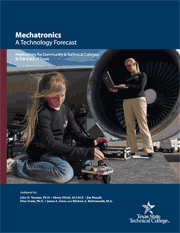
Mechatronics, A Technology Forecast
John H. Vanston, Ph.D., Henry Elliott, M.S.M.E., Jim Brazell, Eliza Evans, Ph.D., James A Irwin, and Michael A. Bettersworth, MAMechatronics is another way of saying "intelligent mechanical systems" and it is the foundation of many 21st century enabling technologies. This publication, co-authored by Technology Futures' staff, includes an overview of mechatronic technology and analysis of related occupations and salaries, inventory of existing mechatronic curriculum and considerations for colleges considering developing related programs and lists of industry experts and mechatronics companies. Texas State Technical College (TSTC) System sponsored the report. The report is housed on the TSTC website. (July 2007)
TFI Provides Top Technology Trends for 2007
For the third year running, Technology Futures provides a list of forward-looking trends for the coming year that will have significant impact on companies that use technology for competitive advantage. (January 2007)
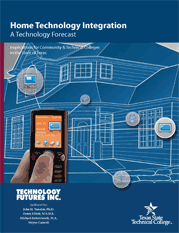
Home Technology Integration, A Technology Forecast
John H. Vanston, Ph.D., Henry Elliott, M.S.M.E., Michael A. Bettersworth, MA, and Wayne CaswellThe market for integrating digital technology into residences is expanding beyond large, custom-built homes and into the broader mass housing market. The home technology integration (HTI) sector includes audio, video, networking, control systems, air conditioning, security and computer technology. This publication, co-authored by Technology Futures' staff, includes an overview of HTI technology, the nature of HTI jobs and skills, a directory of many HTI companies, and market drivers and constraints impacting the HTI industry and employment. Texas State Technical College (TSTC) System sponsored the report. The report is housed on the TSTC website. (December 2006)

Globalization Transformation [PDF]
David Smith, C.A. SkelleyIndustries have to adapt in order to stay competitive, and the manufacturing industry is no exception. More and more corporations are becoming truly global as opposed to simply multinational with consolidated investment, planning, and decision-making functions; trade and supply networks; and production activities and investments spread throughout the world. In this article appearing in the Summer 2006 issue of the Tennessee's Business Magazine, David Smith and C.A. Skelley discuss why and how manufacturers must evolve into a new model of networking and collaboration on a global scale. (September 2006)
Top 7 Technology Trends for 2006
Once again, Technology Futures provides important emerging technology trends for 2006 and beyond developed through our 27 years of forecasting, strategy, and analysis work. David Smith states, "Comparing this year's trends to Technology Futures' list of trends for 2005, we see the trends as being still on the mark, with continuing progress being made in all the areas outlined last year. In this paper we outline some of the developments and provide some new trends and enhancements." (January 2006)
Strategic Roadmaps [PDF]
A popular approach being applied to long-range planning is to produce a roadmap to show the path to the future. Roadmaps and the roadmapping process serve as excellent communications tools--an effective means to link strategic operations, collaborative ventures, and business plans. However, to achieve success, roadmaps must target the right approach, involve the appropriate group intelligence, and provide a specific level of detail. This white paper discusses these elements using an analogy to travel maps. (May 2005) For more information on Technology Futures' activities in this area, please see TFI Roadmapping.
Peer Networks Plague or Promise [PDF]
David SmithThe reemergence of the peer network has begun the discussion of whether there is a way for organizations to capitalize and make money. In this forward-looking article appearing in the April 2005 issue of Phone+, David Smith discusses drivers influencing the adoption of P2P networks and the market. (April 2005).
2005 Trends that will Catalyze the Future
Technology Futures Ushers in 2005 with Special Trend Paper!This special opinion paper provides important emerging technology trends developed through Technology Futures' forecasting, strategy, and analysis work. These trends will be of great consequence to those involved with global business, technology business process, science and universities, government agencies, federal labs, corporate labs, and technology savvy consumers. (January 2005)
Technology Forecasting for Telecommuncations [PDF]
Lawrence K. Vanston, Ph.D. and Ray L. HodgesThis article written by TFI President Larry Vanston and TFI Sr. Consultant Ray Hodges appears in the 4th Quarter 2004 issue of the prestigious international telecommunications journal Telektronikk. For over twenty years Technology Futures has been actively applying formal technology forecasting to the telecommunications industry. Anyone whose future depends on technology markets will find technology forecasting extraordinarily useful both in gaining insight and understanding, as well as in decision making. This article reviews a number of past and current forecasts to give an idea about TFI's experience with technology forecasting and what we see for the future. (4th Quarter 2004)
Emerging Technology Programs for Texas Colleges: Advanced Digital Manufacturing, Hybrid Vehicles, Micro-Electromechanical Systems, and Computer Forensics
Three Emerging Technology Employment OpportunitiesJohn H. Vanston, Ph.D., Henry Elliott
Program Director: Michael A. Bettersworth
A new report by Technology Futures' identifies four emerging technologies worthy of detailed analysis, and found three offered promising opportunities for college graduates. These include advanced digital manufacturing, micro-electromechanical systems (MEMS), and computer forensics. Demand for technical careers in the hybrid vehicles industry was found to be limited. Texas State Technical College (TSTC) System sponsored the report, of which a portion focuses primarily on educational activities in Texas community and technical colleges, while the rest is a resource for a broader-based audience. The report is housed on the TSTC website. (January 2005) Press Release
Homeland Security, A Technology Forecast
John H. Vanston, Ph.D., Henry ElliottProgram Director: Michael A. Bettersworth
This report, written by Technology Futures' staff members, offers information, insights and forecasts for those interested in homeland security. A portion of the report focuses primarily Texas community and technical colleges and homeland security activities in Texas. The rest of the report is a resource for a broader-based audience. The report was written for the Texas State Technical College System (TSTC) and includes analyses of seven technology areas that provide the technical underpinnings for the nation's homeland security agenda: identifications specialists; network security specialists; weapons of mass destruction (WMD) detection specialists; WMD mitigation and decontamination specialists; concealed explosives specialists; critical infrastructure security specialists; and pattern analysis specialists. This report is housed on the TSTC website. (October 2004) Press Release. Texas Press Release.
Testing the Tea Leaves: Evaluating the Validity of Forecasts [PDF]
John H. Vanston, Ph.D. and Lawrence K. Vanston, Ph.D.This article appears in the September-October 2004 issue of The Industrial Research Institute's (IRI) prestigious journal Research-Technology Management. It is an expanded description of Technology Futures' signature white paper, "Testing the Tea Leaves: Formal Methods for Evaluating the Validity of Forecasts" (see below). Because most key decisions are by necessity based on forecasts, it is essential that decision-makers be able to assess the validity of various forecasts. This article provides a set of tools that can assist in discriminating between good and bad forecasts. (Reprinted with permission from IRI.)
Fuel Cells, A Technology Forecast
John H. Vanston, Ph.D., Henry ElliottProgram Director: Michael A. Bettersworth
This report, written by Technology Futures' staff members, offers information and insights for those interested in fuel cells. A portion of the report focuses primarily on two-year Texas colleges and fuel cell activities in Texas. The rest of the report is a resource for a broader-based audience. The report was written for the Texas State Technical College System (TSTC) and addresses the state of the art in fuel cells, the nature and rate of technical advances, potential employment demands, and forecasts and insights on the future of fuel cells. This report is housed on the TSTC website. (December 2003) Press Release. Texas Press Release.

Nanotechnology: A Technology Forecast
Dr. John H. Vanston, Ph.D., Henry ElliottEdited by: Larry Grulick, Ph.D., Michael A. Bettersworth
This report, written by Technology Futures' staff members, offers information and insights that may be of interest to those involved in the nanotechnology and nanoscience fields. The first part of the report (pages 2-20) primarily focuses on two-year colleges in Texas. The rest of the report lends itself as a resource to a broader-based audience. The report was written for the Texas State Technical College System (TSTC) and addresses the current state of the technology, projects the emergence of nanotechnology markets, and examines the factors that might accelerate or deter the development of these markets. This report is housed on the TSTC website. (August 2003) Press Release.
Five Views of the Future™, A Strategic Analysis Framework: Overview and Methods [PDF]
A Signature TFI PaperDr. John H. Vanston, Ph.D.
Technology Futures has developed a strategic analysis framework, "Five Views of the Future™", that allows us to take maximum advantage of a large variety of proven methods when conducting technology/market forecasts. The framework is based on the five ways people view the future as extrapolators, pattern analysts, goal analysts, counter punchers, or intuitors. Descriptions explain the rationale on which each view is based, list several methods that are associated with that view, and indicate whether typical results from each of the methods are quantitative or qualitative in nature. For a more comprehensive description of this model, please see Research-Technology Management's article Better Forecasts, Better Plans, Better Results, written by TFI's Chairman, John H. Vanston, Ph.D.
Better Forecasts, Better Plans, Better Results [PDF]
John H. Vanston, Ph.D.This article appeared in the January-February 2003 issue of The Industrial Research Institute's (IRI) prestigious journal Research-Technology Management. It provides a more in-depth description of Technology Futures' signature Five Views of the Future™, A Strategic Analysis Framework(also see Technology Futures' "Five Views of the Future™" White Paper above). These five views, individually and in concert, provide a foundation for a powerful forecasting program. The article provides descriptions of each forecasting approach, associated forecasting techniques, and illustrations of their usefulness. (Reprinted with permission from IRI.)
Testing the Tea Leaves -- Formal Methods for Evaluating the Validity of Forecasts [PDF]
A Signature TFI White PaperJohn H. Vanston, Ph.D.
Decision makers must--and do--trust their careers to forecasts about the future of technology, market tastes, the economy, the business environment, laws and regulations, and a myriad of other factors. Because of the importance of valid forecasts and because the people charged with making key business decisions typically rely, to a great extent, on forecasts made by others, it is essential that decision makers be able to assess the validity of various market and technology forecasts.
Programs for Emerging Technologies [PDF]
Michael A. Bettersworth, Larry Grulick, Ph.D., and John H. Vanston, Ph.D.Texas State Technical College System, Technology Futures, Inc.
Technology Futures has developed a new process, Programs for Emerging Technologies (PET), in coordination with the Texas State Technical Colleges (TSTC) System for identifying emerging technologies and then forecasting associated technical advances, market developments, and employment opportunities. The process, part of a larger report, was developed to assist the State's community and technical colleges in curricula development. Many of the concepts involved may be useful to others seeking new growth opportunities. (The full report, Forecasting Technical Program Needs, is also available.) (November 2002) Press Release.
Residential Broadband Forecasts [PDF]
Lawrence K. Vanston, Ph.D.This white paper gives forecasts for residential broadband data rates and provides long-term forecasts supporting the view that U.S. broadband adoption is on track and that, barring major business or regulatory mistakes, long-term optimism for broadband is justified. The research supporting this white paper was sponsored by the Telecommunications Technology Forecasting Group (TTFG). (For more on this subject, please see The Local Exchange in 2015.) (October 2002) Press Release.
The Local Exchange Network in 2015
Lawrence K. Vanston, Ph.D.It's 2015. Where are we in the LE telecom technology arena? What are broadband data rates? What's the impact of wireless? What's the network architecture? Viewed from the perspective of 2001, find out author Larry Vanston's scenario backed up his extensive expertise and TFI's technology forecasts. Find out more about 2015 to better prepare for the future! This report sponsored by the Telecommunications Technology Forecasting Group (TTFG). (December 2001) Press Release.
A Structured Approach to Technology Assessment [PDF]
This white paper discusses how to identify emerging advances in technology and analyze the importance, implications, and timing of these advances. These are then used to match advances with the mission, objectives, and capabilities of the organization to determine the actions that must be taken to insure that competitive advantage is achieved. (Reprinted with permission from Austin Software Council.)(2Q, 2001)
Identifying and Evaluating New Product Opportunities [PDF]
Technology Futures, Inc.The rapid pace of advances in technology, the continuing stress on profit growth, and the growing importance of worldwide business competition require that most companies continually develop new products and product lines. However, for these developments to be successful from a business stand-point, the companies must be able to effectively define the market needs of the future, to project advances in technology, be alert to competitor capabilities and intentions, and combine all of these factors into an effective business strategy.
Identifying and Evaluating New Manufacturing Processes [PDF]
Technology Futures, Inc.With technical innovations involving manufacturing processes, the innovation may not be revealed to competitors for a long period of time. Thus, analyzing the current state of the art in manufacturing technology, as well as the probable rate and nature of technical advance in the area, is important in taking full advantage of the advanced manufacturing technology when manufacturing efficiency is a major factor.
Opening New Markets for Existing Product Lines [PDF]
Technology Futures, Inc.The need to find new market arenas for existing product lines or related ones occurs routinely in most businesses. For successful entry into new market areas a company must determine the suitability of the product line to the new market, the present and potential size of the proposed market, possible competitor actions, and the time and effort required to introduce the product line into the new market.
Winning by Coming in Second [PDF]
Technology Futures, Inc.Although there are many good reasons for companies to be the first to offer products and services based on new technologies, there are occasions when this approach is impractical because it may not have the resources to develop the new technology on its own, potential markets may not be sufficiently defined, and the technical potential of the new technology may not be clear. However, if it's decided to go with a "fast follower" approach, a strategy must be carefully crafted, intelligently executed, and infused with an effective surveillance program, since the product initiative will lie with the competition.
Award-Winning Book,
Conference,
Presentations, & Blog
 MINITRENDS: How Innovators & Entrepreneurs Discover & Profit From Business & Technology Trends
By John H. Vanston, Ph.D. with Carrie Vanston
ORDER BOOK
An Eric Hoffer Business Book of the Year Winner
ForeWord Reviews’ Book of Year Finalist
USA Book News Book of the Year Finalist
Dan Poynter’s Global Business eBook of the Year Finalist
MINITRENDS CONFERENCE
Austin, Texas
Fall 2013
Omni Downtown, Austin, TX
Sign up for detail updates.
 MINITRENDS PRESENTATIONS
 BY
DR. JOHN H. VANSTON
 World Future Society Annual Conference
Toronto, Canada
 Metropolitan Breakfast Club
Austin, Texas

RISE Conference
Austin, Texas
View more...
MINITRENDS BLOG
Recieve information, insights, and suggestions on how minitrends can materially improve your life.