

Featured Graph
Excerpted from TFI's report:
Forecasts of Access Line Competition in the Local Exchange
Lawrence K. Vanston, Ph.D.,
President, Technology Futures, Inc.
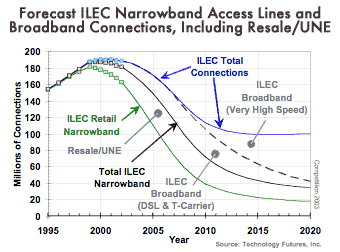
Illustrated in this figure is the forecast transition from standard broadband (as provided by ILECs today on copper cable with DSL or T-Carrier) to very-high-speed broadband (mostly on fiber) that operates at 24 Mb/s or above. The figure assumes that ILECs capture about one-half of the very-high-speed market, meaning that ultimately total ILEC lines stabilize at about 100 million. However, to accomplish this, ILECs must evolve from predominately circuit-switched, narrowband, copper-based networks to packet-switched, broadband, optical-based networks. This will not be easy because competition will be simultaneously stranding large quantities of network investment. The long-run alternative is illustrated by the dashed line in Figure 1.2 with total ILEC access lines falling to 63 million lines by 2015 and 43 million by 2020.
Please visit the report page, Forecasts of Access Line Competition in the Local Exchange for more report information and purchasing details.