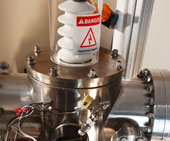
Image: The reactor's central chamber, where fusion happens
[ordering online? -- please see our return/refund policy]
We often find articles about innovations that we feel could impact the future and may be interesting to our visitors who have a stake in forecasting and future-related areas. Future Innovations is a listing of these items with links and a few words about the articles.
Future Innovations is a supplement to TFI's free e-letter, Futures' Features. We thank Bill Kleinebecker for being the initiator and primary contributor to this service. (Please note: Links to outside news outlets may require registration or fees, and may become inaccessible. Articles are in the order that they are submitted.)
Note: We are presently not making new entries to Future Innovations. Below are archives.YouTube for Science?
Slashdot
The world's scientists get a cyber channel. Thanks to Bill St. Arnaud for sending this.--Bill
Researchers design humorous 'bot'
Physorg.com, August 16, 2007, Source: University of Cincinnati
University of Cincinnati researchers Julia Taylor and Larry Mazlack recently unveiled a "bot”--more accurately a software program--that recognizes jokes. They reported the development at the American Association for Artificial Intelligence conference in Vancouver, Canada. All bad jokes aside, their research represents a step forward in computers reaching the capability of a human mind.
Nanowires promise battery-free powering of small devices
Compound Semiconductor, July 2007
The battery has been a great servant for powering devices in situations where mains electricity is inappropriate, but it has its downsides, which include a relatively short life and a toxic composition. ZnO nanowire power generators are free from these weaknesses, and have the potential to drive small devices such as implanted biosensors, says Zhong Lin Wang from Georgia Institute of Technology.
PHOTONIC CRYSTALS: Photons flow in liquid circuits
Laser Focus World, August 1, 2007
By Francesca Intonti, Silvia Vignolini, Marcello Colocci, and Diederik S. Wiersma
Photonic crystals offer promise as a substrate for all-optical devices that may eventually circumvent the intrinsic miniaturization limits of silicon-based integrated electronic circuits.
Invention: biological nanobattery
NewScientist.com news service, July, 2007
By Justin Mullins
Nobody has yet worked out how to make a good nanobattery, so nanoscale devices are typically driven by power sources many times their own size.
A key problem is how to assemble a battery on such a tiny scale, and a number of research groups have been working on exploiting the way biological molecules self-assemble for this task.Presentation
and discussion by avant-garde Architect George Yu
Future Salon, November 2006
Producer: Mark Finnern
The item is part of the collection: Open Source Movies
Presentation and discussion by avant-garde Architect George Yu of his works and the thought process that went into them.
Note: On the video there are 23 minutes of introduction of the Future Salon audience, which you may want to skip. (However, you can't fast forward through it.)
When art and technology converge. The creativity of the late Professor George Yu. Creations can be found at http://www.georgeyuarchitects.com. (See bottom right for "Blow Up" and other projects.)--Bill
Invention:
biological nanobattery
NewScientist.com news service, July 16, 2007
Justin Mullins
Nobody has yet worked out how to make a good nanobattery, so nanoscale devices are typically driven by power sources many times their own size.
A key problem is how to assemble a battery on such a tiny scale, and a number of research groups have been working on exploiting the way biological molecules self-assemble for this task.
Flying windmills could harness the jet stream
NewScientist.com news service, July 26, 2007
By Phil McKenna
Flying windmills tapping jet stream wind currents may sound far fetched, but groups in the US, Netherlands and Canada say such devices may soon be within reach. If successfully developed, they could harness an enormous amount of reliable, renewable energy.
Nanomechanical
computers - an answer to today's power-hogging silicon chips?
Nanowerks, July 25, 2007
By Michael Berger
(Nanowerk Spotlight) Finding out how much power all the computers in the U.S., not to mention the world, are using seems to be an impossible task. . . . Researchers are now proposing to build a fully mechanical computer based on nanoelectromechanical (NEMS) components that would use considerably less energy.
Teen Builds Basement Nuclear Reactor!
Popular Science, July 24, 2007
By Gregory Mone
One high-school students successful quest to create atomic energy, just for kicks. . . . See the bottom of the page for a video demonstration of Thiago Olson's homemade fusion reactor.
Here is a weak signal of the influence that Lo Tech will have on the world, especially if it doesn't have the checks and balances, as well as the visibility that high tech and ultra tech get.--Bill
Scientists say photosynthesis has a key
role in future energy supply
Physorg.com, July 24, 2007
Leading experts in photosynthesis research will discuss tomorrow how understanding the fundamental processes that plants use to turn light into energy is a key way of securing cheap, emission-free energy in the future.
AND
Those
Muscle Cars On the Drag Strip Are Really Electric: Clunker Run on Batteries
Trounces Latest 'Gassers'
Wall Street Journal, August 1, 2007, Page A1
By John J. Fialka
Another citation relating to the last issue of Future Innovations, courtesy of John Vanston of TFI.--Bill
Researchers
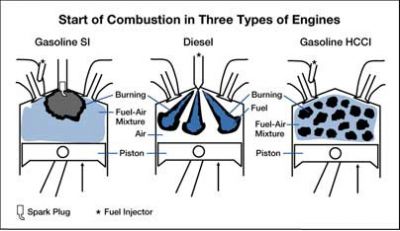
work toward spark-free, fuel-efficient engines
Physorg.com, July 23, 2007, Source: MIT
In an advance that could help curb global demand for oil, MIT researchers have demonstrated how ordinary spark-ignition automobile engines can, under certain driving conditions, move into a spark-free operating mode that is more fuel-efficient and just as clean.
AND THIS......
E-Dragsters
Go for Gas-Powered Records
My Way, Jul 30
By AARON CLARK
PORTLAND, Ore. (AP) - Straddling a 619-pound motorcycle, Scotty Pollacheck tucks in his knees and lowers his head as he waits for the green light. When he revs the engine, there's no roar. The bike moves so fast that within seconds all that's visible is a faint red taillight melting in the distance.
Imagine a chip, strategically placed in the brain, that could prevent epileptic seizures or allow someone who has lost a limb to control an artificial arm just by thinking about it.
This isn't exactly what I normally send out. But it is cool and also an idea of what an information appliance of the future might display. Be sure to look at the info under the "?"--Bill (Thanks to Ray Rose for sending this.)
Evolutionary algorithms now surpass human designers
NewScientist.com News Service, 28 July 2007
by Paul Marks
Charles Darwin's theory of evolution has been the source of much controversy since its publication in 1859, most recently involving the intelligent design (ID) lobby in the US. Now the theory is fuelling another debate, although for once the battle lines have nothing to do with religion.
New,
invisible nano-fibers conduct electricity, repel dirt
Research News, Ohio State University<>
Tiny plastic fibers could be the key to some diverse technologies in the future--including self-cleaning surfaces, transparent electronics, and biomedical tools that manipulate strands of DNA.
Remote control brains: a neuroscience revolution
New Scientist Magazine, Issue 2613, 18 July 2007
By Douglas Fox
In a laboratory in Germany, a tiny worm dances to flashes of light. A flash of yellow and it darts forward. A flash of blue and it jerks back. Yellow, forward, blue, back - right on cue every time.
Speed-of-light computing comes a step closer
NewScientist.com News Service, 18 July 2007
Saswato Das Computers that operate at the speed of light have come a step closer. Researchers have devised a light-based transistor made of semiconducting nanowires that could be a key building block of machines that are hundreds of times faster than today's supercomputers.
Change
to gene theory raises new challenges for biotech
International Herald Tribune, July 3, 2007
By Denise Caruso
The $73.5 billion global biotech business may soon have to grapple with a discovery that calls into question the scientific principles on which it was founded.
A Step Toward a Living, Learning Memory Chip
Science, June 6, 2007
By Nikhil Swaminathan
Israeli scientists imprint multiple, persistent memories on a culture of neurons, paving the way to cyborg-type machines
Everything in the known universe about CES 07: Honda Asimo Humanoid Robot demo
CES 07: Honda Asimo Humanoid Robot demo on Technorati of YouTube: added: January 11, 2007, from: reghardware
Smart clothes to monitor health
BBC News, June 11, 2007
European scientists are developing clothing which they say will be able to monitor your health.
Exfoliation produces lighter, cheaper solar cells
NewScientist.com news service, July 13, 2007
By Belle Dumé
An ultra-thin solar cell that could provide a cheaper, lighter alternative to existing devices has been created by researchers in the US.
The $85 Computer
Forbes.com, May 16, 2007
By Andy Greenberg
"In fact, many consumers don't need to upgrade. A bare-bones computer suits them just fine--and these days, they can buy them for as little as $85."
AND
Dell: 'Nobody Really Wants' a $100 Laptop
E-Week.com, July 10, 2007
By Michael Hickins
NEW YORKMichael Dell doesn't think that making inexpensive laptops for underprivileged kids is very helpful.
Scientists Create Breakthrough Sensor Capable of Detecting Individual Molecules
Physorg.com, July 06, 2007, Source: Caltech
Applied physicists at the California Institute of Technology have figured out a way to detect single biological molecules with a microscopic optical device. The method has already proven effective for detecting the signaling proteins called cytokines that indicate the function of the immune system, and it could be used in numerous medical applications, such as the extremely early detection of cancer and other diseases, as well as in basic biological research.
(c)Copyright 2007 Technology Futures, Inc. All rights reserved.
All product names contained herein are the trademarks of holder.