The displacement of wireline access lines was forecast by Lenz and Vanston3 in 1993 and by Vanston and Rogers4 in a 1995 update. Table 1 shows the more recent forecasts of cellular/PCN subscribers and a baseline projection of access lines as well as the percent of cellular/PCN customers expected to forego wireline service. The last column shows the number of access lines lost to cellular/PCN that is implied by the forecast.
| Table 1 Cellular/PCN Subscriber Forecasts | ||||
|---|---|---|---|---|
| Year End |
Wireline Access Lines (millions) |
Cellular/PCN Subscribers (millions) |
% of WL Access Lines Lost (Cellular/PCN Subscribers Only) |
"Lost" Wirless Access Lines (millions) |
| 1994 | 154 | 22 | 0% | 0 |
| 1995 | 159 | 30 | 0% | 0 |
| 1996 | 163 | 39 | 1% | .4 |
| 1997 | 168 | 49 | 2% | 1.0 |
| 1998 | 173 | 60 | 4% | 2.4 |
| 1999 | 179 | 73 | 8% | 5.8 |
| 2000 | 184 | 86 | 13% | 11.2 |
| 2001 | 189 | 101 | 19% | 19.1 |
| 2002 | 195 | 115 | 26% | 29.9 |
| 2003 | 201 | 130 | 33% | 42.7 |
| 2004 | 207 | 141 | 41% | 59.0 |
| 2005 | 213 | 158 | 49% | 77.6 |
| 2006 | 220 | 172 | 57% | 98.2 |
| 2007 | 226 | 186 | 64% | 118.8 |
| 2008 | 233 | 199 | 70% | 139.2 |
| 2009 | 240 | 211 | 76% | 160.7 |
| 2010 | 247 | 223 | 81% | 181.0 |
| Source: Technology Futures, Inc. | ||||
The projections of percent of wireline access lines lost were based on two limiting factors:
Also, the forecasts did not account for potential price changes by wireline carriers in response to competition or new wireline services such as ISDN that would tend to counteract the abandonment of wireline service.
Based on the forecasts, 1% in 1996 is approximately 240,000 access lines lost, 19% in 2001 is approximately 19 million, and 81% translates into 181 million access lines lost by 2010. To obtain these numbers, however, significant improvements in both service and pricing must be made, since there is little evidence of direct substitution to date. We will review the outlook for wireline quality service and competitive prices
While wireline access cannot provide mobility/portability, cellular can substitute for fixed wireline service. In this case, it is a competitive offering rather than a complementary one. Yet, to date, there has been very little direct substitution. This reflects both higher prices and the fact that cellular has been less than a perfect substitution for wireline in both service quality and versatility (full-time service independent of battery charge and the ability to accommodate extensions, answering machines, and other CPE). Also, with the present cellular duopoly enjoying rapid growth, there has been little incentive for cellular companies to lure wireline customers with attractive pricing structures. This may all change dramatically in the near future.
First, digital technology, coupled with better coverage of the areas where people live and work instead of just where they travel, will greatly diminish the service quality disadvantage of cellular. At least one of the largest cellular companies is adding additional cell sites specifically to improve coverage in residential areas to position its network for high-quality wireless residential service. Also, cellular products are now available which connect to a standard telephone jack (RJ11). The wireline service can be discontinued at the point of demarcation between the customer and the telephone company. Conventional customer premise equipment (CPE) -- standard telephones, answering machines, fax machines, and computers -- interfaces seamlessly with the wireless service just as it did with the wireline service.
ALTERNATIVE WIRELESS ACCESS PRODUCTS
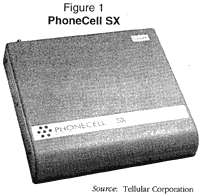
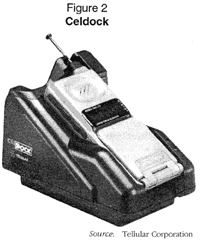
Two products from Tellular Corporation, PhoneCell SX and Celdock, create the same dialtone interface as wireline service. PhoneCell SX (Figure 1) is a direct replacement for the telephone company loop (the connection between the customer location and the telephone company central office), but Celdock (Figure 2) does this and much more. It's an intelligent cellular interface built into a portable cellular phone charger base. It connects to a standard electrical outlet (110 V/AC) and telephone jack (RJ11) and provides complete emulation of a land line over the cellular network. It also offers the portability of a single number anywhere the customer travels. It is important to note that these products are different from others in that they require no special equipment or modification to the cellular network. The decision to forego wireline service is strictly up to the customer and not the cellular provider which may also have an interest in the wireline network. The customer simply buys the CPE, plugs it into a phone jack, and discontinues their wireline service.
Other manufacturers offering a variety of wireless loop (radio links directly from the customer location to the cellular network or the telephone company central office) products are Ericsson, Motorola, Qualcomm, InterDigital, and Hughes Network Systems.
The Ericsson RAS 1000 wireless loop also provides interfaces to other communications devices such as answering machines, fax machines, and modems. Motorola has developed a system specifically designed as a wireless alternative. The system uses conventional cellular frequencies and channel assignments, but requires only part of the regular cellular band because of antenna re-use patterns and narrowband analog technology (N-AMPS).5 Only two bands of 5.5 MHz of spectrum are required for 50,000 subscribers when a six-sector antenna pattern and N-AMPS technology are utilized.6 The significance of this method is that it employs more efficient channel utilization and antenna technology to provide the additional capacity required for fixed location subscribers rather than reducing cellular capacity. The subscriber unit provides what appears to be conventional service, including dialtone, which interconnects with all standard CPE.
Hughes Network Systems' GMH 2000 is being marketed for both conventional cellular and fixed local loop applications. Qualcomm is marketing a wireless local loop system using its code division multiple access (CDMA)7 digital technology. This system transmits across a 1.25 MHz segment spectrum and provides 10 times the capacity of the competitive AMPS8 systems presently in service.9 The Qualcomm System also supports a variety of standard wireline type interfaces. It also has the added capability of an Integrated Services Digital Network (ISDN) primary rate interface which can be easily integrated with existing digital end offices or switches.10 Motorola Personal Communications Systems has already introduced a new product for quick, cost-effective wireless loop services at PCS frequencies for the U.S. and international markets -- even before PCS is operational. The new product, called Teledensity, is designed to be quickly installed and provide low-cost, high-capacity wireless voice and data service in urban and suburban environments.
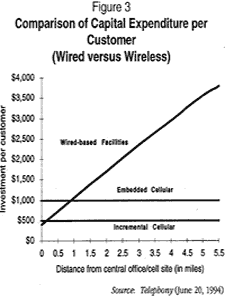
Most of these wireless alternative products are enjoying greater success in the markets of developing nations, where 80% of the world's population has less than 20% of the phones,11 than in the United States where essentially everyone has wireline service available and at very low (often below costs) prices. Wireless is a very quick and cost effective way to implement telephone service especially in less dense areas where longer loops are required. Figure 3 shows that even at embedded investment levels, cellular is less costly at distances greater than one mile from the central office.
CELLULAR COST VS. PRICE
Today, cellular customers are being added to existing systems for about $500 per customer, and the cost is expected to continue to decline while the cost of wireline facilities (especially the copper loop) are expected to increase. In addition, the cost of maintaining the copper-based network has been estimated at two times that of wireless systems.12 On a pure costs basis, the time may be near when the total costs of wireless fall below the variable costs of wireline loops. Admittedly, regular wireline subscribers use their telephones about three times as much (in terms of busy hour traffic on the network) as do cellular customers. Usage is the primary driver of costs on the cellular network, since it requires no physical connections from the network to the customer. Thus, the costs of using cellular as a substitute for wireline service is about three times the current $500 per incremental cellular customer cost with today's AMPS technology. Even so, the capital costs would be less for cellular than wireline loops over 9,000 feet. Also, digital technology, both TDMA13 and CDMA, and advanced antenna technology will continue to reduce the costs for the additional traffic carrying capacity needed for fixed location subscribers. I expect the costs of adding fixed wireline customers utilizing digital technology to actually be less than $500 per customer in the near future even with higher usage for fixed service. New technology coupled with the additional PCS spectrum soon to be operational will provide ample capacity at continually decreasing costs. The real question is whether there will be a glut of capacity resulting in airline style price wars. In this scenario, the copper loop will be as economically obsolete as a fleet of DC-3s.
GTE MOBILNET
The current situation is that technology is available and on the market that should make wireless telephone service an economical alternative, but will the customer accept it? GTE Mobilnet tested an offering in the Tampa Bay area in which customers were asked to give up their wireline service. In turn, they were provided a specially-designed OKI handset and base equipment which functioned very much like the Tellular CelDock. Their monthly charges included flat rate usage from their home cell. When the handset was used outside the home cell, regular cellular usage charges applied. The base unit connected to the telephone jack and provided an interface for the normal household or office CPE. The results of the particular part of the trial that quantified customer acceptance levels has not yet been publicly released. However, based on discussions with a small number of participants, I believe that it was quite well accepted at the trial prices.
GTE has since introduced a somewhat similar offering, "Tele-Go" with one critical difference -- it encourages continued use of wireline services. Tele-Go utilizes a specially-designed OKI handset which also operates like a high-quality 900 MHz cordless phone. When the handset is used in conjunction with the Enhanced Cordless Basestation (ECB), calls are routed over the wireline network with no usage charges. When outside the range of the ECB, the regular cellular network is utilized and usage charges are applicable according to a special schedule with lower rates than cellular for a base area and higher rates for an extended premium area. This offering is designed to compete with future new PCS offerings rather than to lure wireline customers. However, it puts wireless handsets in more homes and lets customers become accustomed to using wireless in conjunction with primary telephone service. All that remains to be done to have customers cut the cord is for wireless providers to offer attractive prices.
CYBERTEL CELLULAR
CyberTel Cellular in Kauai, Hawaii has recently received approval from the Hawaii Public Utility Commission to implement digital cellular rates of $18.00 per month which includes 400 minutes of use. Additional usage beyond 400 minutes is $.09 per minute. Tellular alternative access products are being promoted to directly challenge wireline service, much of which was wiped out by Hurricane Iniki. They also have a total of four plans for increasingly heavy users according to the schedule in Table 2.
| Table 2: CyberTel Monthly Charges for Digital Cellular Service | ||
|---|---|---|
| Plan | Cost | Additional Usage |
| Digital Plan I -- per cellular number, including 400 minutes of usage per month (peak or off-peak) | $18.00 per month | $.09 per minute over 400 minutes |
| Digital Plan II -- per cellular number, including 600 minutes of usage per month (peak or off-peak) | $22.00 per month (limited to one Block) | $6.00 for additional block of 100 min. usage $.09 per minute over 600 |
| Digital Plan III -- per cellular number, including 800 minutes of usage per month (peak or off-peak) | $35.00 per month (limited to one Block) | $6.00 for additional block of 100 min. usage $.08 per minute over 800. |
| Digital Plan IV -- per cellular number, including 1,200 minutes of usage per month (peak or off-peak) | $44.00 per month (limited to three Blocks) | $6.00 for each additional block of 100 min. usage $.07 per minute over 1,200 |
| Source: Cybertel Cellular Application to Hawaii PUC, Effective June 24, 1994 | ||
These prices are being implemented as GTE Hawaii pursues substantial increases for wireline service in an effort to move local wireline service closer to actual costs. Presently, GTE's wireline rates are value-of-service priced where exchanges (islands) with the greatest calling scope in terms of customers accessible within the local calling area have the highest rates. This concept of pricing is known as value-of-service pricing and was almost universally used by telephone companies for residential service during the monopoly era. As an example, the residential rate on the heavily populated island of Oahu is $13.50 per month, while the rate on Lanai is only $9.25. This relationship is the exact opposite of the cost relationship on a per customer basis and is only sustainable in a monopoly environment. GTE is proposing to move to uniform rates throughout the islands. This will help reduce the inverted price/cost relationship, but still will not entirely eliminate it. This move will lessen the threat from fiber-based competitive access providers (CAPs) in the densely populated areas where wireline service may be priced considerably above costs. However, it will make the less densely populated islands much more vulnerable to wireless access providers such as CyberTel with their new digital offerings. Table 3 show GTE's present and proposed rates as filed with the Hawaii Public Utility Commission in Docket #7579.
| Table 3: GTE Residence Individual Line Rates | |||
|---|---|---|---|
| Current | Proposed | % Change | |
| Oahu | $13.50 | $21.95 | 62.6 |
| Hawaii | 12.25 | 21.95 | 79.2 |
| Maui | 11.70 | 21.95 | 70.2 |
| Kauai | 11.70 | 21.95 | 67.6 |
| Molokai | 10.15 | 21.95 | 116.3 |
| Lanai | 9.25 | 21.95 | 137.3 |
| GTE Business Individual Line Rates | |||
| Current | Proposed | % Change | |
| Oahu | $33.35 | $43.90 | 31.6 |
| Hawaii | 24.70 | 43.90 | 77.7 |
| Maui | 22.75 | 43.90 | 93.0 |
| Kauai | 22.75 | 43.90 | 93.0 |
| Molokai | 18.45 | 43.90 | 137.9 |
| Lanai | 16.25 | 43.90 | 170.2 |
This head-to-head competition should answer the question of whether people are truly ready to cut the cord. Cellular is being offered at rates which are comparable to wireline and with equipment that will emulate the service quality and features of wireline service. The Kauai case exemplifies what I believe will become the rule rather than the exception. As local exchange carriers de-average prices and attempt to move to cost-based pricing of local rates, overall prices must increase with the less densely populated areas increasing the most. While this strategy will reduce the threat of some forms of competition, such as fiber-based CAPs, it will increase the vulnerability to wireless bypass.
If GTE is successful in obtaining its proposed rates, we will have a real test of customer willingness to abandon wireline service for wireless at comparable prices. This case will be followed closely and will be reflected in future forecasts since it should be a precursor of things to come. LECs will move prices upward to match actual costs to reduce competitive threats in other business segments. Wireless will reduce prices in response to increased wireless competition and technology driven costs decreases.
The forecast of the percent of customers foregoing wireline for wireless service is quite low in the near term of 1995 through 1998. However, competition among wireless providers will heat up as PCS providers bring more capacity on-line, and wireless prices begin to approach costs. The projection of 81% lost by 2010 may appear high to many but reflects the logical conclusion of these trends. Of course, a clearer picture will emerge based on actual results of preliminary trial offerings, such as Tele-Go and CyberTel Kauai.